Cam Hazzard is a partner in The Athlete Spotlight and earns a share of revenue when athletes join. His results are his own experience, not a typical result and not something we promise.
An athlete federation profile is the official record of you published by the body that governs your sport: the World Dunk Association, World Athletics, a national or state federation, a results database like TFRRS, a film platform like Hudl, a recruiting site like MaxPreps, or your school’s athletics roster. It is third-party, verified, structured data about you that you cannot fake, and it is the single strongest proof source most athletes have and never claim.
This is the Athlete Spotlight differentiator. A business owner’s personal brand rests on press and testimonials. An athlete has something better: governing bodies that publish verified results under your exact name. When a recruiter, Google, or an AI engine asks “is this person legit?”, an official record answers with a sanctioned result instead of a self-claim. This article is the standard for finding, claiming, fixing, and interlinking every one of those profiles so they work for your name.
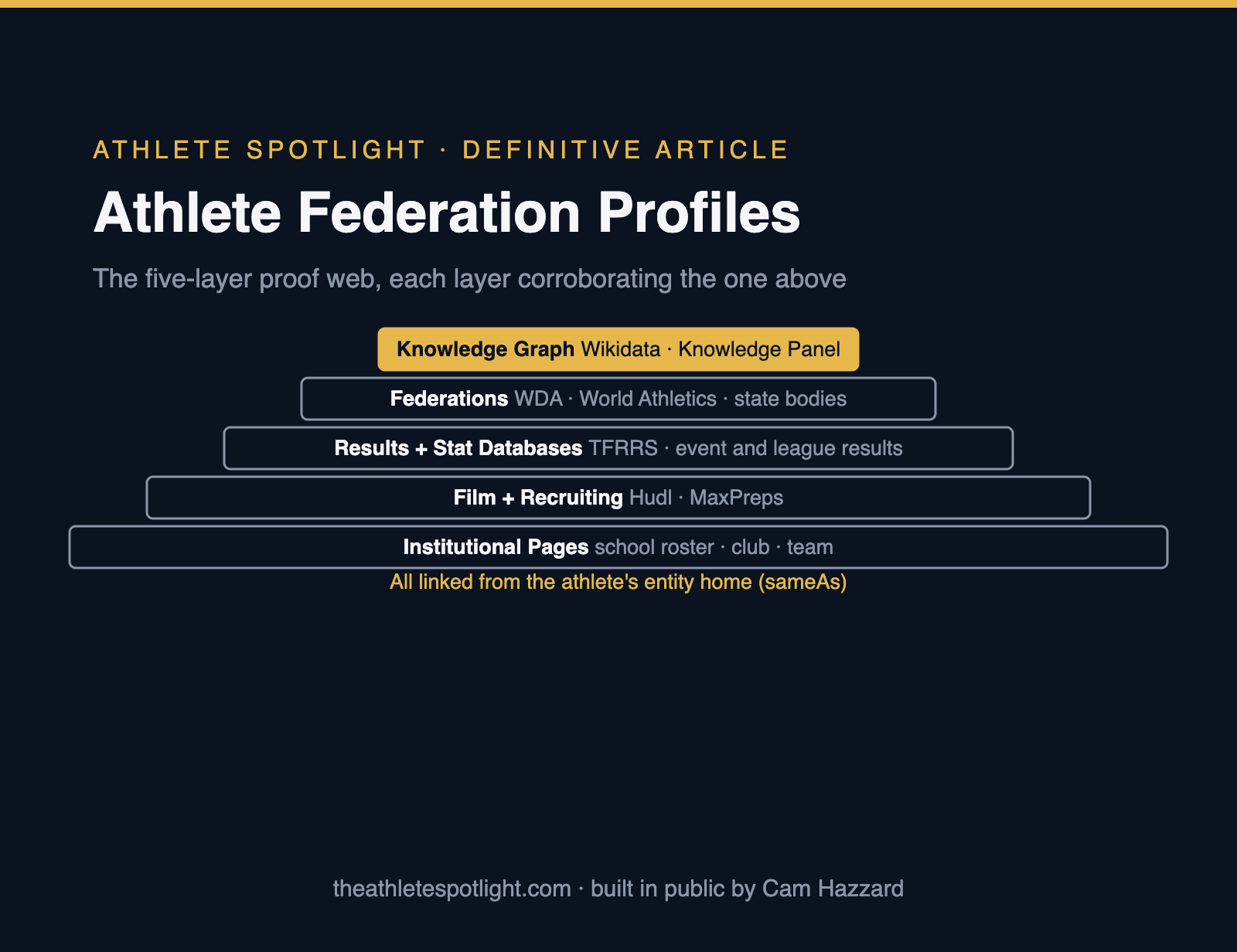
The Athlete Proof Web
Five layers of official record, each corroborating the one above, all tied to your own site.
▲ each layer corroborates the one above
Your entity home
⇆ sameAs array + Connect page + About quick-facts, interlinked with every layer both ways.
Why federation profiles matter more for athletes
Google’s Knowledge Graph, Wikidata, and AI engines treat federation and stat-site profiles as high-trust corroboration precisely because you cannot fake them. They are the proof recruiters and search engines trust most. This connects directly to how Google’s Knowledge Graph decides who an entity is and how a Knowledge Panel gets built.
The problem is that most athletes never claim or complete these profiles. They sit half-empty, misspelled, or missing a photo, while carrying exactly the authority the athlete needs. A complete, interlinked official record is also a visible professionalism signal to a recruiter or sponsor before anyone watches a single clip.
What official records answer that a website cannot
A website is a self-claim. However well built, it is the athlete talking about the athlete. Federation profiles are the answer to the skeptic scenario that every recruiter and every AI engine runs: “Is this person actually who they say they are?”
- In AI search, an assistant asked “how good is this athlete?” or “is this athlete’s vertical real?” looks for corroboration it can trust. A governing-body record with a sanctioned result is exactly that. An athlete with no official footprint gets a shrug or a hallucination; an athlete with a complete federation web gets a confident, correct answer.
- For Knowledge Panel readiness, Wikidata identifiers pointing at athlete databases are the references that raise Google’s confidence that the entity is real and notable. Feeding those identifiers is step 5 below.
- For general AI-encyclopedia readiness (the kind of open, machine-built reference that pulls from structured sources), the same principle holds: verified, interlinked official records are the citations these systems weight, because they are the ones that are hard to fake.
The through-line is simple. The website is where the athlete tells their story; the federation profiles are where independent bodies confirm it. AI search and Knowledge Panels are built from that confirmation, not from the story alone.
The profile map: find every one that applies
Search every layer for the athlete’s exact name and known results, and inventory what you find:
- Sport federation or governing body. The World Dunk Association, World Athletics, national and state federations for the sport. These prove sanctioned results, records, and athlete status.
- Results and stat databases. TFRRS for college track and field, event and league results pages. These prove verified performances with dates.
- Film and recruiting platforms. Hudl, MaxPreps, sport-specific recruiting databases. These carry film, measurables, and team history.
- Institutional pages. A school or university athletics roster, club and team pages. These prove affiliation, position or event, and season stats.
- Knowledge graph. Wikidata (athlete-database identifier properties) and the Google Knowledge Panel. This is the machine-readable identity that ties everything together.
The six-step standard
1. Inventory. Search every layer of the map for the athlete’s name and for known event results. List each profile found: URL, claimed status, accuracy, completeness, and whether a photo is present.
2. Claim what is claimable. Hudl, MaxPreps, recruiting platforms, and many federation portals have a claim or edit flow. Use the athlete’s long-term personal email, never a school email that expires. For minors, this needs a guardian.
3. Fix and complete. Make the exact name spelling match the entity home, add the consistent headshot, the one-line bio, the current team, and the entity home URL in the website field wherever one exists. For records that carry an error (a wrong spelling, a missed result), file the correction through the body’s official process and log the request date.
4. Interlink. Add every federation and stat-site profile URL to the entity home in three places: the Person schema sameAs array, the Connect page official-profiles list, and the About page quick-facts table. Where a platform allows a link back, point it at the entity home. The sameAs array is where the athlete site standard consumes these, so this step is what closes the loop between the official record and the site.
5. Feed the knowledge graph. Add athlete-database identifiers to the athlete’s Wikidata item where properties exist for the sport’s databases, with the profile URLs as references. This is the single move that does the most for Knowledge Panel confidence.
6. Monitor per season. New results, new teams, new records: re-sweep after every season and major event, update the profiles, and re-verify that every link still resolves.
The honesty rule that makes this work
Never fabricate or inflate a record to a governing body. One dishonest correction request can poison an athlete’s standing, and the entire value of this layer is that it is verified. Person is not team is not event: link entities to each other, do not blur them. And a fixed record you cannot edit still counts. If you cannot change it, link to it and let it corroborate you.
This is the same engine as everything else in the Athlete Spotlight method: one clear entity, many independent sources agreeing. Federation profiles are simply the strongest independent sources an athlete will ever have.
Worked example: Cam Hazzard and the World Dunk Association
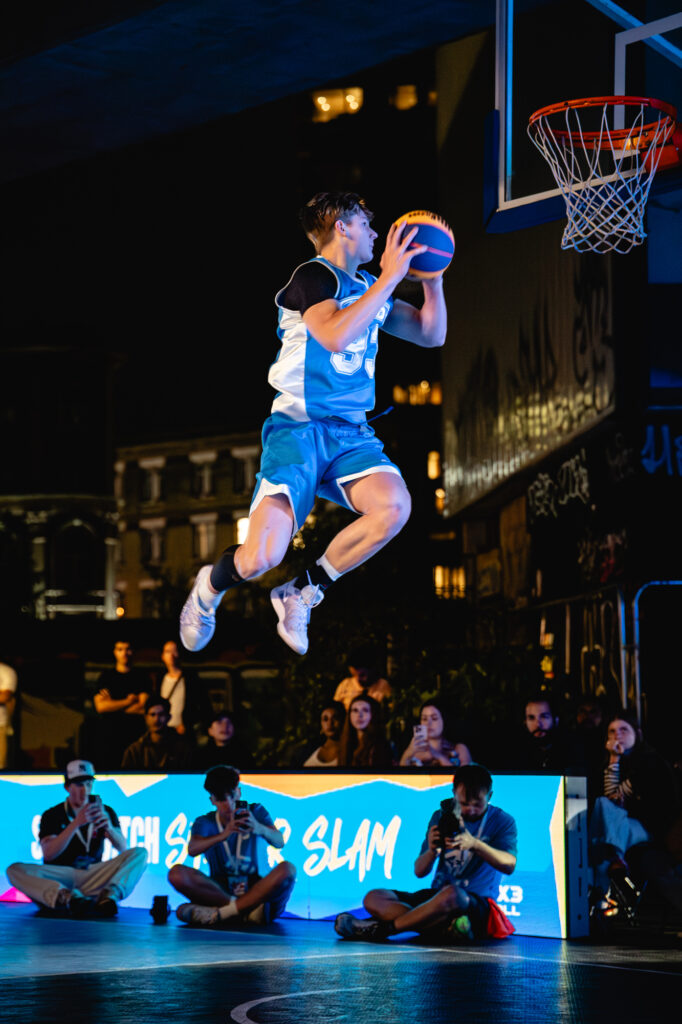
Cam Hazzard is a professional dunker, one of the athletes selected for the DunkMan League. His World Dunk Association profile is a governing-body record of his identity and status as a pro dunker. Linked from camhazzard.com’s schema and Connect page, it corroborates his story, including a verified 50-inch vertical, to Google and to every AI engine that gets asked whether he is legit.
The same-name problem makes the official link even more valuable. Cam shares a similar name with a Canadian hockey player, a known search-results collision. The World Dunk Association link pins the right person to the right sport, which is exactly what an entity home needs when a namesake competes for the same search results. This is why the federation profile is not optional polish; it is the piece that disambiguates the athlete for the machines that decide who shows up.
Real examples
- Cam Hazzard’s World Dunk Association profile (wda.do/dunkers/2dcbf5ca-cameron-hazzard), the governing-body record above, interlinked from his entity home’s schema and Connect page.
As more athletes are onboarded and their federation profiles claimed, completed, and interlinked, each becomes another named example here, per the rule that a definitive article links to as many real examples as exist. TFRRS profiles for track athletes, Hudl and MaxPreps profiles for recruits, and state-federation records will populate this section as those builds ship.
For athletes and parents
If you are the athlete: your federation profile is the one page about you that nobody can argue with. Claim it, complete it, and make your site and the official record point at each other.
If you are the parent: this is an afternoon of unglamorous work with outsized payoff, and much of it (claims and correction requests) needs a guardian’s help for minors. Do it once, then it is maintenance.
Your edge: most competitors have unclaimed, half-empty official profiles. A complete, interlinked official record is a professionalism signal to recruiters and sponsors before anyone watches a single clip.
Related frameworks
- The Athlete Spotlight User Journey, the end-to-end path this standard supports.
- How we build an athlete personal brand website, whose
sameAsarray and Connect page consume these profile URLs. - Google’s Knowledge Graph and the Knowledge Panel, what a complete federation-profile web feeds.
Get started
The full breakdown of what is included lives on the Athlete Spotlight package page. When you are ready, get started for $30 per month and we inventory, claim, and interlink your official profiles as part of building your presence. Parents are welcome to check out on an athlete’s behalf.
Third-party validation
The proof in this article is, by design, third party. Cam Hazzard’s status as a pro dunker is recorded by the World Dunk Association, an independent governing body, not by us and not by him. That is the entire point of the federation layer: the corroboration comes from bodies that publish verified results, which is why Google, Wikidata, and AI engines weight it so heavily.