Cam Hazzard is a partner in The Athlete Spotlight and earns a share of revenue when athletes join. His results are his own experience, not a typical result and not something we promise.
Dennis handed me 250 skills. I had 21. On 2026-07-08 I downloaded Dennis Yu’s two skill packs, a 239-task library and a personal-brand agent pack, and diffed them line by line against my own operating system: 21 local skills and 24 canon frameworks, last synced to his live site on July 2.
The surprise was not what I was missing. It was what the skill packs were missing. The downloaded packs still taught rules Dennis’s own live site retired months ago. That turned a simple import job into something better: a sync with an authority ruling, sync to the source, not the artifact.
The sync at a glance
Sync to the source, not the artifact.
Diffed
239
task-library skills
+ 11
personal-brand pack files
vs. 21 local skills
vs. 24 canon frameworks
Authority order
1. Dennis’s live articles
2. His downloaded packs
3. The local system
Result
10
upgrades adopted (same day)
4
rules refused (site retired them)
70+ Rank Math → 81+
first-link-only → retired
Reconciling the skill packs without vandalizing either side
The assignment: reconcile Dennis’s downloadable skill packs with my system without vandalizing either. The sources were all 11 personal-brand pack files plus its README, roughly 120 of the 239 task-library skills read in full (every personal-branding, SEO-architecture, dollar-a-day, and thank-you-machine file, plus the key content-factory and website-QA files), both manifests, and the local counterpart for each.
The goal category is the anti-reinventing-the-wheel discipline Dennis asked for on the July 7 call: ask for the latest skill packs before building anything. So before I built the athlete pack, I made sure I was building on his newest thinking, not a stale copy of it.
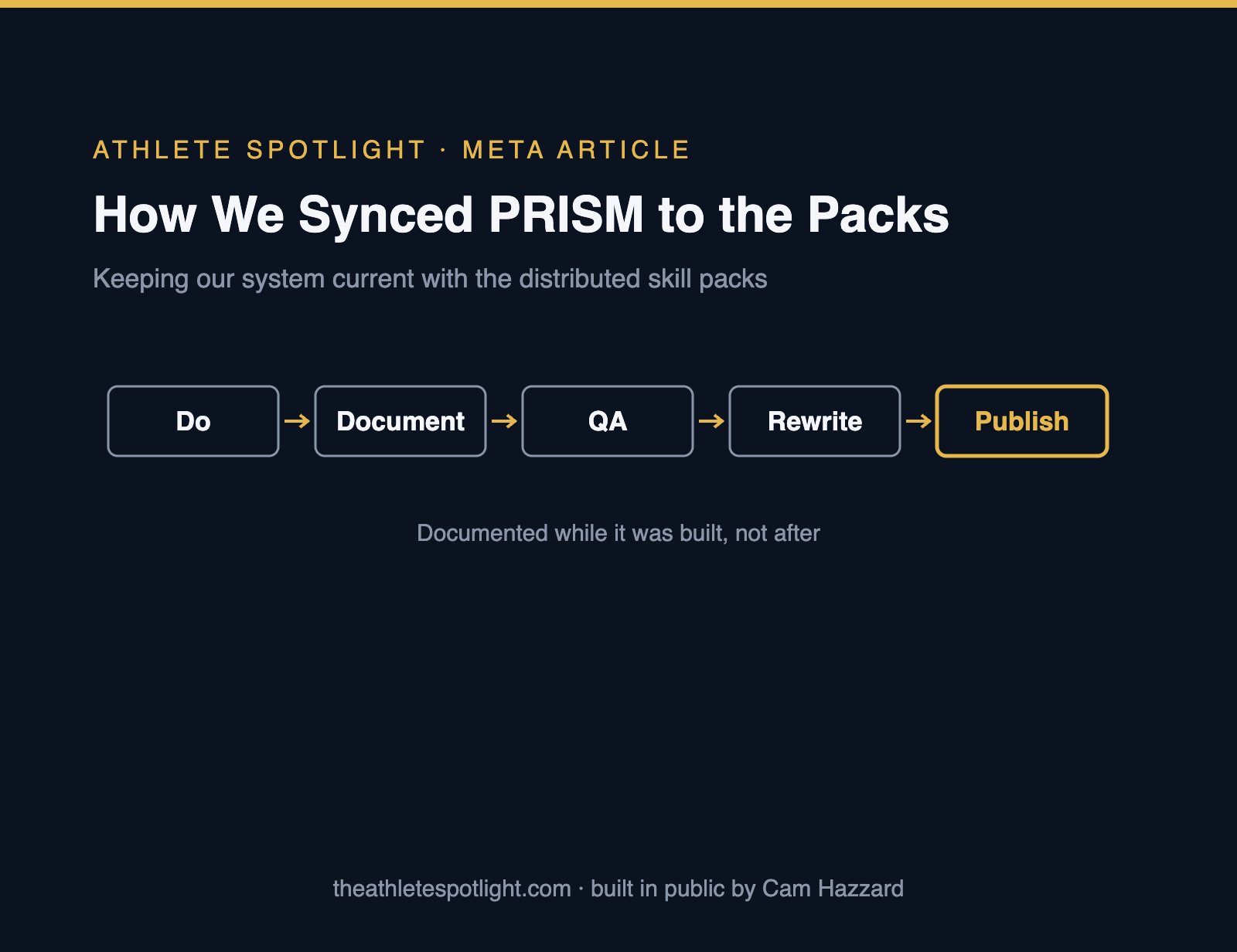
How the sync ran, step by step
- Download and map. Both packs into a scratchpad, and a map file recording where every skill lives.
- Diff. A six-section comparison: what is new in the packs, where the packs beat the local system, where the local system beats the packs, the athlete-vertical candidates, the canon gap (I hold 24 frameworks, the registry lists 27), and a ranked list of sync actions.
- Rule on authority. When sources conflict, the order is Dennis’s live articles first, his downloaded packs second, the local system third. The packs are snapshots; the site is the master. One deliberate exception: the no-em-dash rule is local policy by design and never gets synced away.
- Execute the adoptions. Ten imports, same day, each new file carrying its source path and a “Dennis Yu / BlitzMetrics, adapted” attribution.
- Refuse the stale rules. Four pack teachings did not come in, because the live site supersedes them.
- Give first. The diff itself became a gift: a drafted note to Dennis flagging that his shipping packs contradict his live site in those four spots, plus a broken starter-zip link I found on the way.
The ten adoptions included the agent operating layer, an AI-search-visibility skill, a personal-brand strategist, a 30-point mention rubric folded into my Positive Mentions System (built by Cam Hazzard, developed with Dennis Yu), four Dollar a Day patches, a recursive self-improvement QA pass, and about two dozen new website-QA checks. The four refusals: the Rank Math 70-plus threshold (live guidance is 81-plus green), the first-link-only anchor rule (retired on the entity-linking page), the Link Whisper install step (AI agents replaced it), and the 8-section homepage (the newer pattern is 9 sections with a dynamic blog loop).
The calls I’d defend
Live site beats the packs, even though the packs are “official.” Newest published Dennis is the master. Without that ruling I would have imported a 70-plus Rank Math threshold my own July 2 sync had already retired. Freshness is a property of sources, not of formats.
Patch, don’t rewrite. Existing skills got cross-referenced additions, not wholesale replacement. Anti-vandalism applies to your own repo too.
Don’t guess the missing canon. The packs cite hubs suggesting three frameworks I do not hold. Instead of inventing them, the action is to get the source repo invite and read the real list of 27.
Defer the shiny thing. The athlete-vertical pack build was the obvious next product, and I explicitly did not build it in this session. Sync first, build second, per Dennis’s own layers: strategy, then local prototype, then cloud.
What it cost, honestly
Honest label: no token receipt (the metrics extractor is still an open gap), so these are documented estimates. The reading volume is the honest driver: about 120 of 239 task files read in full, not skimmed, because the whole point was catching contradictions.
| Task | Agent time (est.) | Human time (est.) | Agent cost (est.) | Human cost (est.) |
|---|---|---|---|---|
| Read ~131 pack files plus local counterparts, write the diff and map | one long session | 3 to 4 days of careful reading | a few dollars in tokens | $840 to $1,120 at $35/hr |
| Execute 10 adoptions plus supersession notes | ~1 to 2 hours of session time | 1 to 2 days | low single-digit dollars | $280 to $560 |
What the agent did, and what a human owns
Autonomous: reading both packs completely, diffing against local files, drafting the authority ruling for approval, executing the imports with source attribution, and writing the supersession notes inline.
Human required: the authority ruling itself was Cam’s call, made explicitly on 2026-07-08. Sending the give-first note to Dennis is Cam’s send. The source-repo invite is a human ask. And the deferred athlete-pack build waits for a human green light.
What the agent read
Pack files read: all 11 personal-brand pack files plus README, about 120 of 239 task-library skills, and both manifests. Local files read: the 21 skills, the relevant canon, and the July 2 live-site sync records. Live-site fetches: a delegation skill that was in neither pack, plus spot-verifications of entity linking and Rank Math guidance. Tokens: not measured. Voice profile: applied to this write-up.
How it scores against our own gate
This article ran through the same 18-step gate we use on client work. Passing now: first sentence under 10 words, zero banned words, zero em dashes, contractions throughout, and all counts traceable to the diff and sync records. Still needs a human: the featured image (the diff’s summary table is a candidate screenshot), Cam’s fact pass, and confirmation that Dennis is fine with the pack-contradiction findings going public. That last one is a real gate, not a formality.
Put the synced system on your Claude
The whole point of the sync was to keep the method current, then hand it to athletes. You can put the Athlete Spotlight system on your own Claude in about a minute, free Claude included. This is one of three meta articles on the wider build; the others cover how the weekly report’s site-health half was built and how positive mentions were wired into athlete sites.
The lesson I keep coming back to: don’t sync to the artifact, sync to the source. The packs were the map; the live site was the territory. And when your teacher’s own materials drift behind his newest thinking, catching it and handing it back is the best thank-you there is.
Built by Cam Hazzard, developed with Dennis Yu.