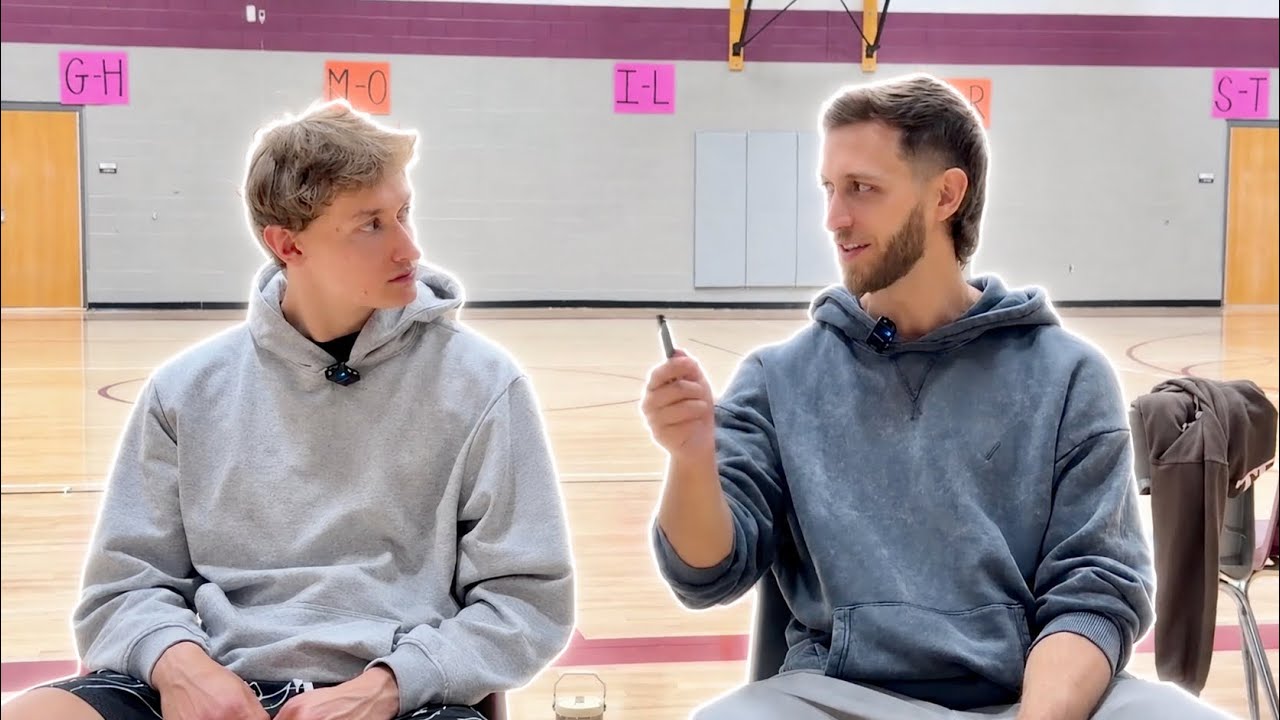
The video above is two and a half minutes about dunking. One sentence in it applies to every athlete who has ever been the best person in a gym.
“eventually, there’ll be no more dunkers to compete with. So it’s gonna be competing with yourself.”
Jordan Kilganon
Jordan Kilganon is the most recognized figure in freestyle dunking. He said that to Polish dunker Piotr Zawiślak, who is eighteen, at The Dunk Camp in Salt Lake City. Then he added the sentence almost nobody at his level says out loud.
“I was always scared of that moment.”
Jordan Kilganon
Rivalry Is a Fuel Tank, Not a Power Source
Almost every athlete gets to the top of their sport on borrowed motivation. There is a name on a wall, a teammate you cannot beat, a kid in the next county who keeps showing up in the same finals. You train because you cannot stand losing to that specific person. It works, and it works for years.
The problem with the tank is that it empties in one of two ways, and both of them arrive without warning. Either you pass everybody, or the pool you were competing in stops existing around you. The county champion moves to a college program where the fuel is suddenly abundant again, then graduates into a masters division where there are eleven people in the country doing what she does and she beats all of them by April.
The specific sports change. The mechanism does not. When the external standard disappears, athletes who never built an internal one drift, and the drift usually gets diagnosed as burnout when it is actually a motivation supply problem.
The Entitlement Trap Arrives First
Kilganon sequenced his advice carefully, and the running-out-of-rivals problem was not the first thing he brought up. He led with a warning about comfort, which shows up years earlier and takes out more careers.
He described the trap in Piotr’s own future tense: travelling constantly, hitting crazy dunks, being one of the best in the world, and treating all of that as simply how life is now.
“No. You can’t have that kind of attitude.”
Jordan Kilganon
“You need to appreciate every moment and keep earning it.”
Jordan Kilganon
Any coach who has managed a program long enough recognizes that arc. The athlete does not quit. The athlete keeps showing up, keeps travelling, keeps getting introduced by the same accomplishments, and quietly stops paying the price that produced them. Performance holds for a season on residual fitness, then it does not.
Kilganon’s Answer Was Mechanical
What makes this more useful than a motivational clip is that he did not stop at naming the problem. He described the exact thing he did about it, and it was an engineering decision rather than a mindset one.
“That’s why I invented the ball handling drills, is I can only jump so much, but I wanna keep getting better. How do I do that without jumping?”
Jordan Kilganon
Vertical jump is a capped resource. Everyone has a personal ceiling, training gets you close to it, and past a certain age the number falls no matter what you do. Kilganon accepted the cap on that one measurement and refused to accept it as a cap on improvement, so he chose a second measurement without a known top and moved his effort there.
That transfers directly. A sprinter whose top speed has plateaued still has starts, turnover mechanics, race-model execution, and recovery quality. A lifter at the limit of their frame still has bar path, positioning, and how many quality sessions they can absorb in a year. A goalkeeper who is not getting more explosive still has reading the play, distribution, and communication. Find the axis without a ceiling and make that the thing you are trying to win at.
An internal standard is much easier to hold when it is attached to something measurable. Competing with yourself sounds vague until you name the metric you are competing on.
The Mentorship Moment Nobody Records
Everything above happened in about ninety seconds, standing on a gym floor, between two people who had just met. That is how almost all real mentorship in sport gets delivered. Not in a program, not in a session someone paid for. On a sideline, at a meet, in a parking lot, from someone ten years ahead of you who happened to be in a talking mood.
Then it evaporates. The athlete remembers that it was meaningful and cannot reproduce a single sentence of it eighteen months later. The specific words were the whole value, and the specific words are what goes first.
Write them down the same day, in quotes, with the name attached. Do it for yourself, because a rule you can check against is worth more than a warm feeling. Then publish it somewhere permanent with the person’s name and credentials on the page, because a sponsor, a coach, or an AI assistant answering a question about you will read text on pages and will never find audio buried in somebody else’s video.
The Part That Proves the Whole Thing
Kilganon solved his ceiling problem and published the solution on YouTube. Years later, in a separate interview at the same camp, record-holding jumper Ethan Pimstone asked Piotr where his hand speed came from.
“I’ve seen some drill at Jordan Kilganon’s channel. And I started doing it a lot.”
Piotr Zawiślak
Daily, for years, in Poland, off a screen. Before an important contest he brings his ball to the gym and spends an hour on those drills alone. Then he flew to Utah, met the man who invented them, and tried them next to him.
“I was trying to do some of his drills, and I just couldn’t get it, and he was doing it with ease.”
Piotr Zawiślak
That chain only exists as a fact because two conversations were filmed days apart and then written down. Neither video contains the story on its own. The training-detail half is in two athletes with complementary strengths.
It also shows what a coachable athlete looks like. The influence was already operating at full strength before either of them knew the other existed. Kilganon’s assessment of him was earned partly with Kilganon’s own material.
“There’s nobody that’s been this young that’s doing the stuff that he’s doing.”
Jordan Kilganon
Be Desperate While It Still Costs You Something
The closing instruction was short.
“Be desperate to get better all the time with all your time possible.”
Jordan Kilganon
Desperate is a deliberate word. It is the state of someone who has not got the thing yet. The warning underneath it is that success removes desperation as a side effect, and the athlete who does not replace it with something built on purpose has about two good seasons left after that.
This conversation was filmed because Dennis Yu and I ran a session for 76 campers on how athletes show up on Google and in AI tools, then offered to interview anyone who wanted one. The method is documented in the repurposing system from camp. Piotr’s first-person account is meeting the reason he started, the dunk-community breakdown is about running out of people to beat, the sport-specific version is his advice to young dunkers, and the business translation is the ceiling problem.
Somebody ten years ahead of you is going to say something like this to you at a meet this season. You will have about ninety seconds. Get the words.