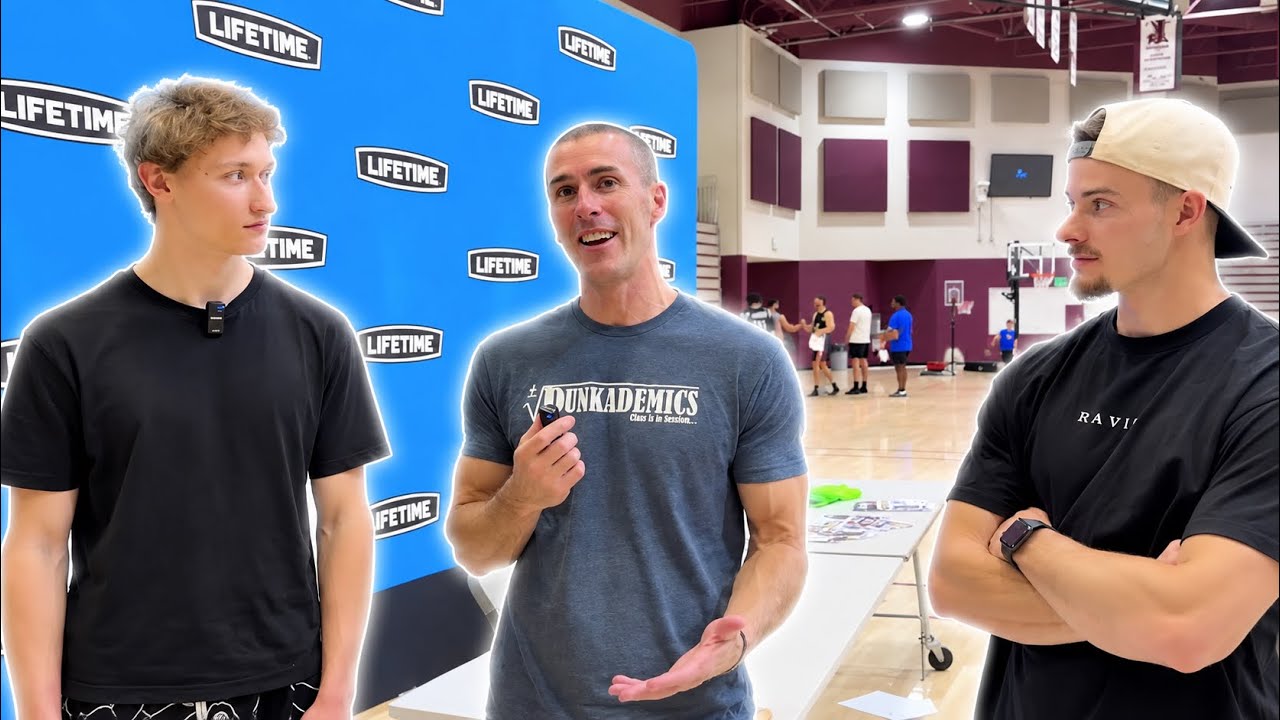
The video above is four minutes of three guys talking about dunking. The thing that happens in it happens in every sport, every weekend, to athletes who then let it evaporate.
Here is the setup. Billy Doran of Dunkademics has been filming freestyle dunkers since 2007. In that sport, his camera is the closest thing to a governing body. At The Dunk Camp in Salt Lake City, he pointed it at an eighteen-year-old from Poland named Piotr Zawiślak and gave an evaluation.
“He’s crazy. He’s young in the game and he’s already black band. That’s, it’s insane.”
Billy Doran, Dunkademics
Sixty seconds of footage. In most athletes’ hands it becomes a story post that disappears in 24 hours. In this case it became a permanent, citable record, and the difference between those two outcomes is entirely a matter of what happened after the camera turned off.
Every Sport Has Someone Whose Camera Confers Status
Freestyle dunking has Dunkademics. Powerlifting has the meet-day film crews and the federation accounts. Track has a handful of highlight pages that decide which high schoolers the country hears about. Climbing has route setters and film crews with more reach than any sanctioning body. Wrestling has the recruiting services. BMX and skating have video parts, which have functioned as a career currency for forty years.
These people are not neutral. They are the ones who decide what the sport looks like to everybody who is not in the room. Getting on their camera is the closest thing a non-mainstream athlete has to being drafted, and unlike being drafted, nobody sends you a certificate afterward.
Identify who that is in your sport. There are usually two or three. If you cannot name them, you are not paying attention to how your own sport distributes attention.
The Evaporation Problem
The clip goes up on their account, not yours. You do not control it, you cannot edit it, and you cannot guarantee it will still be there next year. It is not searchable by your name. If a sponsor, a coach, or a meet director goes looking for evidence that you are worth backing, they will not find it, because a video on somebody else’s page does not surface for a query about you.
The same is true of AI assistants, which increasingly sit between an athlete and the person deciding whether to fund them. A model answering “who are the best young dunkers in Europe” reads text on pages, not comment sections under a reel. If the strongest thing ever said about you exists only as audio inside somebody else’s video, it functionally does not exist.
This is not a hypothetical loss. Most athletes have already had two or three of these moments and cannot produce a single link to any of them.
Capture It the Same Day
Get the actual URL, not a screenshot and not a repost. Put it somewhere you will look again, which is not your camera roll. Ask the person filming whether you can use the footage, and most of the time the answer is yes, because they filmed you to build their own library and yours is a rounding error.
Write down what they said word for word. This is the step nearly everyone skips, and it is the one that carries all the value. “He’s already black band” tells a reader something specific about where an athlete sits in a ranked system. “Billy said good things about me” tells them nothing and reads like self-promotion.
Then publish it on a page you own, with the person’s name, what they run, how long they have been doing it, and a link to them. That context is what turns a quote into evidence. A reader who has never heard of your sport needs to be told why this person’s opinion is worth anything.
Keep the Criticism In
The most useful sentence in the whole interview was not the praise. It was the answer to a direct question about what Piotr needs to become the number one dunker in the world.
“if he gains a few inches of vert… ’cause he’s already got the hand speed, the technique stuff like that.”
Billy Doran, Dunkademics
One variable. Everything else already at standard. That is a training plan, and it is also the thing that makes the rest of the evaluation trustworthy, because an assessment with a flaw in it reads as real and an assessment without one reads as a favor.
So ask for the critique on camera. Ask the person filming what is holding you back. Most athletes are too nervous to ask and end up with three minutes of compliments they cannot use. Piotr got a number he can train against, and he wrote it down himself in his account of the day he was filmed.
The Moments With No View Count
Hyrum Fechser was standing in that interview too. He had arrived at camp late and missed the session everyone was talking about.
“I wasn’t at Dunk Camp until now, so this was the coolest part for me, seeing all these guys in person.”
Hyrum Fechser
Nobody was filming that specifically. It has no metrics attached. It only survives because someone transcribed the interview and wrote it into an article, which is a fair summary of the entire argument here: the things worth keeping are almost never the things the algorithm rewarded that day.
Billy also named the dunkers who impressed him most across two decades of filming. His all-time pick was T-Dub, for balance and style rather than for jumping the highest, and most of the other names on his list got there the same way. That is worth noticing if you compete in a judged or filmed sport: the person who decides what your discipline looks like to outsiders may be grading something other than the number you train for. His own version is the most impressive dunkers he has filmed, and the sport-specific breakdown is the full list on Dunk Talk.
This interview exists because Dennis Yu and I ran a session for 76 campers on how athletes get found on Google and in AI tools, then offered to film anyone who wanted it. The system is documented in the repurposing system from Dunk Camp. The dunk-specific case for treating footage as a credential is getting filmed is a credential, and the search reasoning is in coverage from the authority in your niche.
Somebody in your sport is going to point a camera at you this season. What happens in front of it is your training. What happens after it is your career.