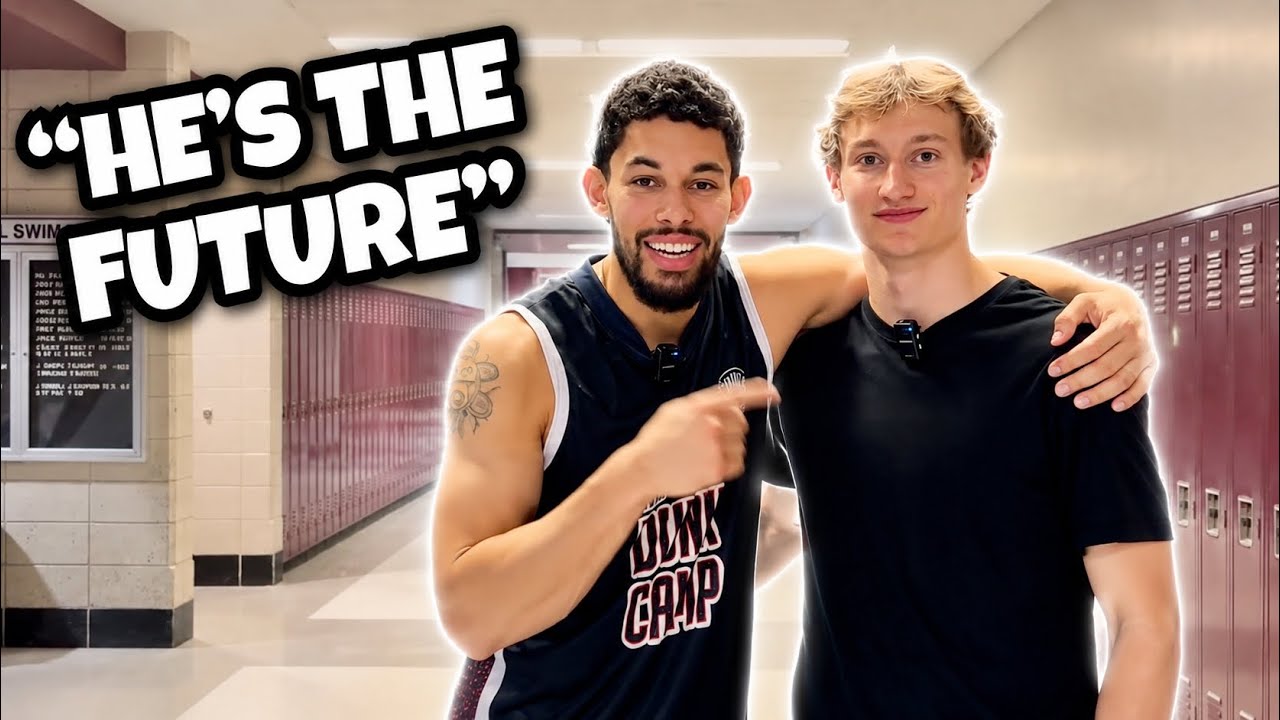
You can buy followers. You can buy ads. You can pay someone to write a very flattering bio about you. The one thing you can’t buy is a respected person in your sport saying, on the record, that you’re the future of it.
That happened on camera at The Dunk Camp 2026 in Salt Lake City. Isaiah Rivera, one of the highest jumpers alive and a professional dunker since he was 18, was asked what he thought of an 18-year-old Polish dunker named Piotr Zawiślak.
“He’s the future, man. He is the future.”
Isaiah Rivera
The sport here is dunking. The mechanic is identical for a distance runner, a boulderer, a wrestler, a swimmer, or a high school junior trying to get a coach to open an email. Somebody with standing in your sport vouching for you in public is worth more than every sentence you’ll ever write about yourself.
Why the Source Matters More Than the Words
Everything an athlete says about themselves gets automatically discounted by the reader. That’s not cynicism, it’s just how people process claims. A recruiter reading “elite work ethic and explosive first step” on a profile assigns it close to zero weight, because the person with the most to gain wrote it.
A third party changes the math. The person vouching has their own reputation attached to the claim, and they lose something if they’re wrong. That’s the entire reason a coach’s reference letter carries weight and a self-summary doesn’t.
Isaiah gains nothing from praising a younger dunker who is closing the gap on him. He said it anyway, and then he made it worse for himself by being specific.
Specifics Are the Whole Asset
“I missed 360 Underboth a bunch of times. You hit it second try at a session.”
Isaiah Rivera
Read that as a competitor rather than a fan. A pro at the top of his sport publicly stated that he repeatedly failed at something a teenager landed on the second attempt, in the same building, on the same day. That’s not a compliment, it’s a data point with a witness.
“I can’t fathom even doing the stuff you’re doing at 18 years old.”
Isaiah Rivera
He kept going. He said his own vertical at that age was nowhere near 44 or 45 inches, that his first 360 Eastbay barely went down, and that watching this kid made him feel old. Then he zoomed out past both of them: “it also shows me how much the dunk game’s evolving.”
Translate that pattern into your sport. “She’s fast” is worthless. “She ran a 4:52 in a race I was pacing and had another gear at 1200 meters” is a credential. “Strong climber” is worthless. “He flashed a V9 that took me four sessions” is a credential. The endorsement that travels is the one with a number, a scene, and a person who lost something by saying it.
The Advice Had Almost Nothing to Do With Athletics
Before the co-sign, Piotr asked Isaiah what it takes to become one of the best. Isaiah gave three rules. Never stop, including through injuries. Enjoy it, because nobody competes forever. And in the middle, this.
“The pro dunking game, you gotta get good at social media. You gotta get good at marketing yourself. That’s a skill in and of itself, so master that.”
Isaiah Rivera
“all of us, myself, Jake Clark, Jordan Kilganon, 1FootGod, we all mastered the social media game as well.”
Isaiah Rivera
One of three rules for reaching the top of a physical sport, from someone who reached the top of it, is about distribution. He named four athletes at the peak of dunking and identified the shared trait as marketing skill rather than athletic ability. Every serious sport now has some version of this, whether it’s NIL deals in college athletics, shoe sponsorships in trail running, or gear partnerships in climbing.
Two days earlier, Dennis Yu and I taught a classroom session at that same camp telling 76 athletes exactly this. We had audited all 76 beforehand and published the results at the Dunk Camp 2026 athlete audit leaderboard. The whole session is written up at the repurposing system we taught 76 athletes. Isaiah wasn’t in that room and had no idea what we’d said. He got there on his own, from inside the sport.
What Recruiters and Sponsors Actually Do
They search your name. That’s it, that’s the whole process, and it takes about ninety seconds.
Increasingly they also ask an AI assistant who you are, and the assistant answers from whatever it can find written down about you. If the only things findable are your own social accounts and a stat line, the answer is thin. If a respected figure in your sport has publicly said something specific about you, and that statement lives on a page with your name on it, the answer changes.
The failure mode isn’t that athletes don’t have endorsements. It’s that the endorsements happen in gyms, at meets, in team vans, and in DMs, and then they disappear. Nothing was recorded, nothing was published, so nothing is findable. Athlete Spotlight exists to fix that specific problem: give an athlete one page they control where the proof actually lives and search engines can read it.
Ask, Record, Publish
The practical version is three steps, and none of them require money.
Ask a real question. Piotr didn’t ask Isaiah for a compliment, he asked what it takes to become one of the best. The endorsement came out as a byproduct of a genuine conversation, which is also why it doesn’t sound rehearsed.
Record it. A phone is fine. The Isaiah clip is under two minutes and it’s the most valuable thing in Piotr’s file, more than any highlight reel, because a highlight reel only proves you can do something once.
Publish it in text as well as video. Search engines and AI tools read words far more reliably than they watch footage. A video sitting on a phone helps nobody. The same video embedded on a page, with the quotes typed out and attributed, becomes something a stranger can find and cite.
The Rest of This Conversation
Piotr wrote his own account of what the moment meant to him at Isaiah Rivera called me the future. All three of Isaiah’s rules are broken down for the dunk community at Isaiah Rivera’s three rules for young dunkers.
Why capturing a co-sign turns a moment into a permanent credential is covered at when your idol co-signs you on camera. And the search and AI mechanics, meaning what a co-sign does to how machines understand who you are, are at why an expert co-sign is an entity signal.
Isaiah’s third rule was to enjoy the moments, because nobody competes forever. Fair. Record a few of them on the way through, and they stay useful long after you stop.